How AI Food Scanning Apps Work (and How Accurate They Are)
How AI Food Recognition Actually Works
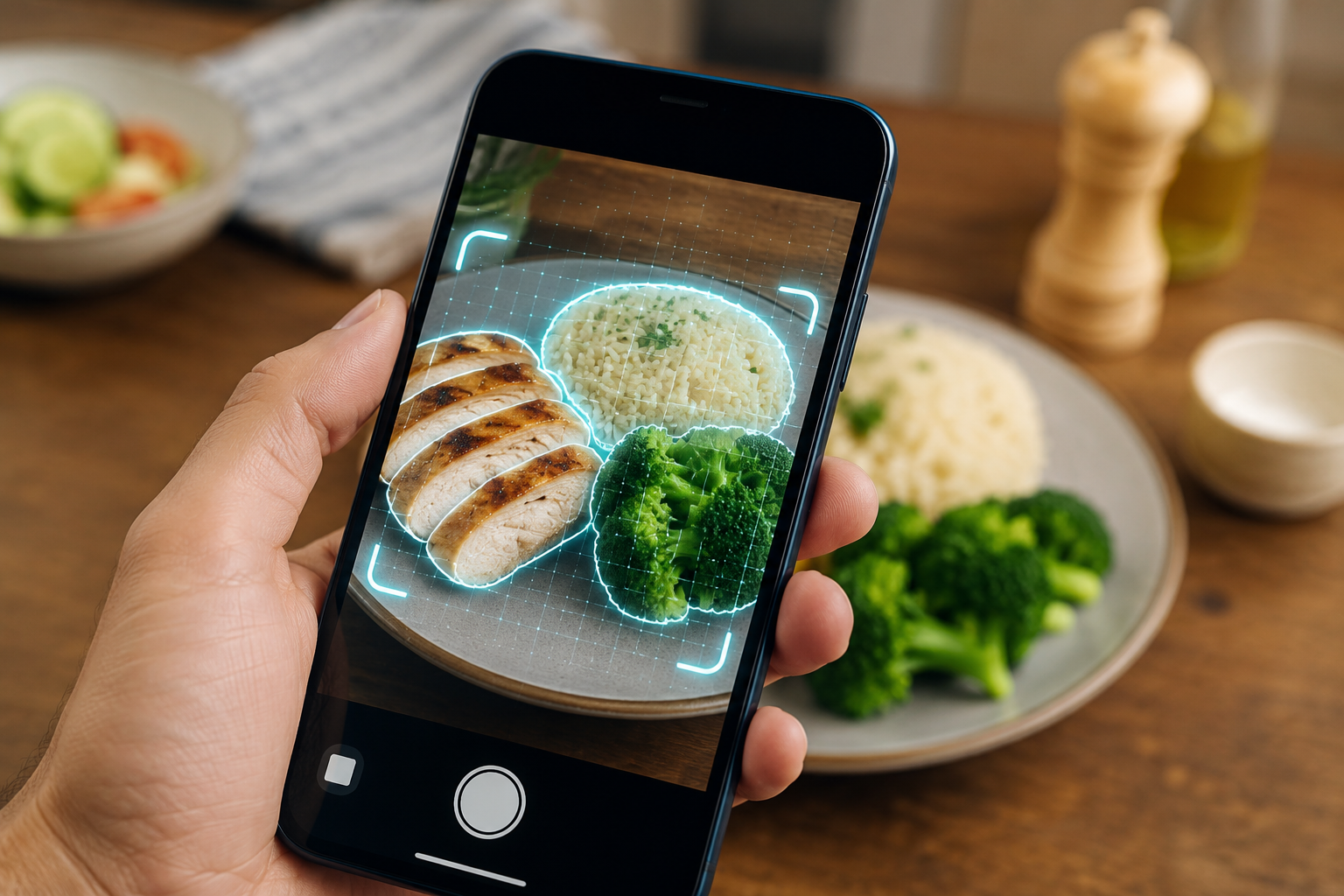
How does AI food recognition work? When you snap a photo of your meal in an app like Caloura, the image is analyzed by a machine learning model trained on millions of food photos.
When you snap a photo of your meal in an app like Caloura, the image is analyzed by a machine learning model trained on millions of food photos. The AI identifies what's on your plate - say, grilled chicken, rice, and broccoli, then estimates portion size based on visual cues like plate size, depth, and volume. From there, it matches the identified foods against a nutrition database to calculate calories, protein, carbs, and fats.
Why Photos Instead of Manual Search?
Manually searching a food database and adjusting portion sizes for every single meal is one of the biggest reasons people quit calorie tracking, it's slow and tedious. Photo scanning cuts this down to a few seconds: point, snap, and the app estimates the rest. This is especially useful for home-cooked meals or mixed dishes that don't have a barcode to scan.
This is the core advantage of photo based calorie tracking: point, snap, and the app estimates the rest, instead of manually searching a database for every item.
How Accurate Is It, Really?
How accurate is AI food scanning, really? It's very good at identifying what food is on your plate, and reasonably accurate at estimating portions for common single-item foods like a piece of chicken, an apple, or a bowl of rice.
AI food scanning is very good at identifying what food is on your plate, and reasonably accurate at estimating portions for common single-item foods like a piece of chicken, an apple, or a bowl of rice. Where it's naturally less precise is with heavily mixed dishes, like a stir-fry or casserole, where ingredients are visually blended together, since the AI is estimating from an image rather than measuring the physical ingredients that went in.
For most people, this level of accuracy is more than good enough. Calorie tracking is about weekly consistency, not gram-perfect daily precision, an AI estimate that's off by 10-15% still gives you a far more accurate picture than not logging a meal at all, or guessing without any tool.
Tips to Improve AI Scanning Accuracy
- Take photos from directly above the plate when possible, in good lighting
- Separate mixed foods slightly on the plate so components are more visible
- Use barcode scanning for packaged foods instead of photo scanning, since it pulls exact label data
- Adjust the estimated portion size manually if you know it's noticeably off
- Log consistently so small estimation errors average out over the week
AI Scanning vs Manual Logging
Manual logging can be more precise for packaged foods with visible labels, but it's slower and requires more effort per meal. AI scanning trades a small amount of precision for a massive gain in speed and convenience, which, in practice, means people are far more likely to actually stick with tracking long term. Caloura combines both: use the AI scanner for quick estimates on home-cooked meals, and barcode scanning for exact data on packaged products.
The Bottom Line
AI food scanning won't be perfect down to the gram, but it's accurate enough for real, sustainable calorie tracking, and far faster than manual logging. Caloura's AI scanner is free to use with no subscription, making it easy to log meals in seconds and stay consistent with your goals. Download Caloura and try it on your next meal.
AI calorie counter accuracy
Overall AI calorie counter accuracy is more than good enough for real-world use, calorie tracking is about weekly consistency, not gram-perfect daily precision.
As a free AI food scanner app with no subscription required, Caloura makes it easy to log meals in seconds and stay consistent with your goals.
Enjoyed this article?
Start your nutrition journey with Caloura.