Calorie Deficit Calculator: How Many Calories Should You Eat to Lose Weight?
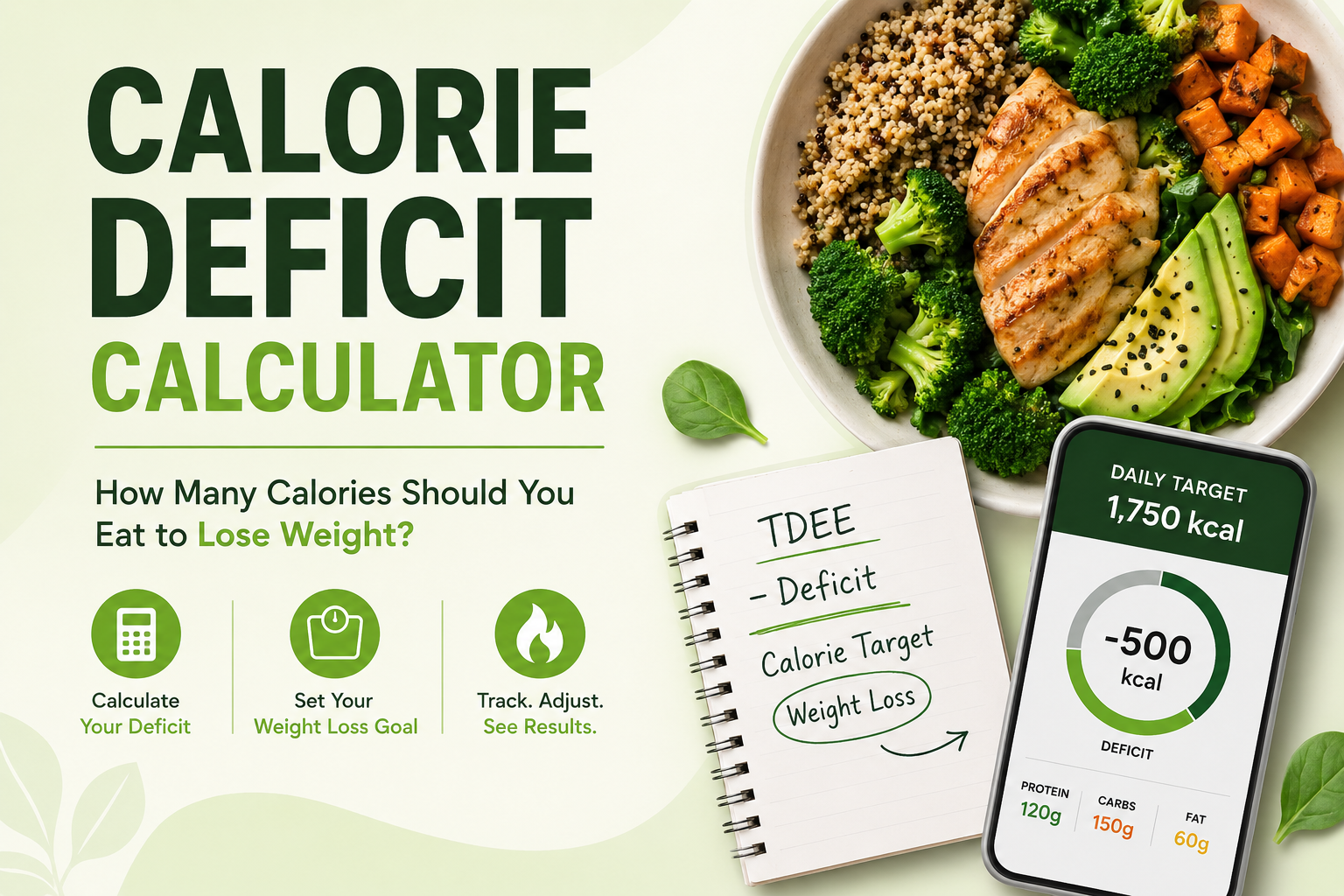
If you've ever typed "how many calories should I eat to lose weight" into Google, you've probably landed on five different calculators that gave you five different numbers. That's frustrating, but it's not because any of them are wrong — it's because a calorie deficit isn't one-size-fits-all. This guide breaks down exactly how to calculate yours, what a healthy deficit actually looks like, and how to avoid the mistakes that stall most people's progress.
What is a calorie deficit?
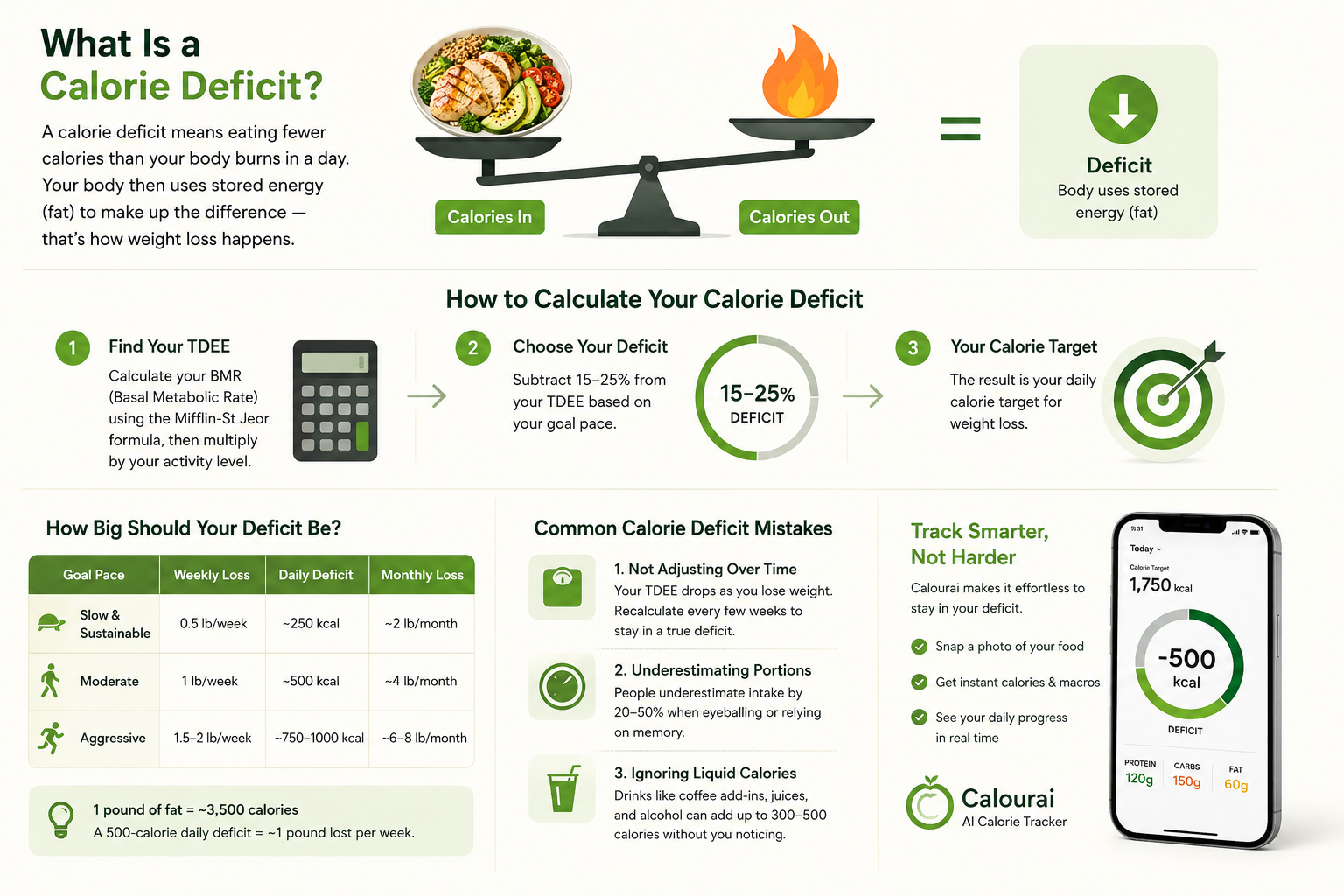
A calorie deficit simply means eating fewer calories than your body burns in a day. When that happens, your body makes up the difference by pulling energy from stored fat, which is what causes weight loss.
The opposite is also true: eat more than you burn, and the surplus gets stored, mostly as fat. This is why calorie counting works regardless of whether you're doing keto, intermittent fasting, or just eating "clean" — every one of those approaches only leads to weight loss if it results in a deficit. The diet style is just the vehicle; the deficit is the mechanism.
Step 1 — Find your maintenance calories (TDEE)
Before you can calculate a deficit, you need to know your Total Daily Energy Expenditure (TDEE) — the number of calories your body burns in a day at your current weight and activity level. This includes your resting metabolism, digestion, and any movement or exercise you do.
TDEE is calculated using your age, sex, height, weight, and activity level, most commonly with the Mifflin-St Jeor formula:
- Men: (10 × weight in kg) + (6.25 × height in cm) − (5 × age) + 5
- Women: (10 × weight in kg) + (6.25 × height in cm) − (5 × age) − 161
That number is your Basal Metabolic Rate (BMR) — calories burned at complete rest. To get your TDEE, you multiply your BMR by an activity multiplier:
Activity Level --> Description --> Multiplier Sedentary--> Little to no exercise, desk job--> 1.2 Lightly active--> Light exercise 1–3 days/week --> 1.375 Moderately active Moderate exercise 3–5 days/week 1.55 Very active --> Hard exercise 6–7 days/week --> 1.725 Extremely active --> Physical job or twice-daily training --> 1.9
Most people overestimate their activity level, which is one of the biggest reasons a "calculated" deficit doesn't produce results. If you're not sure, it's safer to round down.
A calorie deficit calculator does this math for you automatically — no manual formulas, no guessing your activity multiplier. Caloura calculates your personalized TDEE and daily calorie goal directly from your body data, so you get an accurate starting number in seconds.
Step 2 — Choose your deficit size
Once you know your TDEE, subtract calories to create your deficit. How much you subtract determines how fast you lose weight — and how sustainable the process is.
- Small deficit (250–300 calories/day): ~0.5 lb (0.2–0.25 kg) per week. Easiest to stick to, minimal muscle loss, best for smaller amounts of weight to lose.
- Moderate deficit (500 calories/day): ~1 lb (0.45 kg) per week. The most commonly recommended range — noticeable progress without extreme hunger or fatigue.
- Aggressive deficit (750–1000 calories/day): ~1.5–2 lb (0.7–0.9 kg) per week. Faster results, but harder to sustain, more likely to cause muscle loss, and generally only recommended short-term or under supervision.
As a general rule, most people should avoid eating below 1,200 calories/day (women) or 1,500 calories/day (men) without medical guidance, since going too low can slow your metabolism, increase muscle loss, and make the deficit harder to sustain long-term.
A real example
Take a 34-year-old man, 180cm tall, 90kg, moderately active (exercises 3–4x/week). His TDEE works out to roughly 2,700–2,800 calories/day. Choosing a moderate 500-calorie deficit puts his target around 2,200–2,300 calories/day, which should produce about 1 lb (0.45 kg) of weight loss per week — a pace that's fast enough to stay motivating without being unsustainable.
Step 3 — Track your calories consistently
Knowing your number only matters if you actually hit it. This is where most people fall off — not because the math is wrong, but because manual logging is tedious enough that it stops happening.
Modern calorie tracking apps remove most of that friction. Instead of manually searching a food database for every ingredient, AI food scanning lets you snap a photo of your meal and get a calorie estimate in seconds, and barcode scanning pulls exact nutrition data for packaged foods instantly.
The goal isn't perfection — it's consistency. Logging 80% of your meals accurately every day beats logging 100% perfectly for three days and then quitting.
Common mistakes that stall a calorie deficit
- Not adjusting as you lose weight. Your TDEE drops as your body weight drops, since a lighter body burns fewer calories. A deficit that worked at 90kg won't work the same at 80kg — recalculate every 10–15 lbs (4–7 kg) lost.
- Underestimating liquid and restaurant calories. Coffee drinks, alcohol, and restaurant meals are some of the easiest places to blow a deficit without noticing, since restaurant portions often run 2–3x a home-cooked serving.
- Judging progress by a single day on the scale. Body weight fluctuates 1–2 kg day to day from water retention and digestion. Look at your weekly average trend instead of any single reading.
- Going too aggressive, too fast. A deficit that's too large often backfires through intense hunger, low energy, and eventually bingeing — which erases the deficit entirely. Slower and sustainable beats fast and abandoned.
Do you need to recalculate your deficit?
Yes — periodically. As you lose weight, your TDEE decreases, which means the same calorie target that created a deficit at your starting weight may only maintain your new weight a few months later. This is one of the most common reasons weight loss "plateaus" even though nothing about the person's habits has changed.
Caloura automatically recalculates your calorie goal as your weight changes and shows your progress in daily, weekly, and monthly charts, so you can see your actual trend instead of getting thrown off by normal day-to-day fluctuation.
Start today with Caloura — 100% free
Caloura gives you a personalized calorie deficit calculation, macro tracking, hydration log, progress charts, and smart reminders — all completely free, with no subscription required. Unlike most calorie tracking apps that lock core features behind a paywall, Caloura's full logging experience stays free for every user.
Enjoyed this article?
Start your nutrition journey with Caloura.